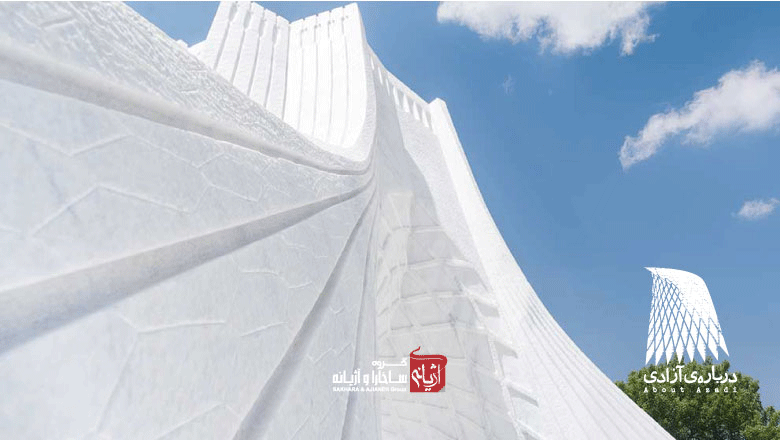

About Azadi
The "About Azadi" initiative originated with archival research and document curation led by researcher and writer Meraj Ghanbari. This endeavor yielded rare archival photographs, historical blueprints, foundational articles, and direct communications with key figures involved in the construction of Azadi Square. Over the past year, portions of these findings were published across more than 40 articles and posts on Sakhara & Ajianeh's website and Instagram channels.
Our corporate heritage at Sakhara & Ajianeh is intricately bound to this historical national monument through the pivotal role played by the late Master Ghaffar Davarpanah during the construction of Azadi Tower. His instrumental influence in sourcing and processing the required natural stone blocks, alongside his continuous on-site oversight of stone installation through to the final day of the project, inspired us to launch the "About Azadi" campaign. This initiative aims to highlight the influential figures behind the project, celebrate their collaborative synergy, and shed light on previously overlooked technical aspects of its architectural design and engineering, publishing these findings across various platforms.
The "About Azadi" initiative originated with archival research and document curation led by researcher and writer Meraj Ghanbari. This endeavor yielded rare archival photographs, historical blueprints, foundational articles, and direct communications with key figures involved in the construction of Azadi Square. Over the past year, portions of these findings were published across more than 40 articles and posts on Sakhara & Ajianeh's website and Instagram channels. Additional ongoing initiatives under this campaign include the production of a feature documentary film, the sculpting and donation of a replica stone statue of Azadi Tower to the Faculty of Fine Arts at the University of Tehran, and hosting the official "About Azadi" commemoration event at the Parsian Esteghlal Hotel, detailed in the report below
Slightly over half a century ago, a landmark was erected in the western periphery of the capital that became recognized as the icon of modern Iran, evolving across subsequent decades into one of the nation's most profound political, social, and cultural symbols. Shahyad Square—known today as Azadi Square—is deeply woven into the collective memory of generations: a monument forged through 28 months of relentless engineering labor and craftsmanship.
Exactly 53 years later, on the evening of October 21 (29th of Mehr), a commemoration ceremony titled "About Azadi" was hosted by the Sakhara & Ajianeh Group at the Parsian Esteghlal Hotel. The gala was convened to honor the legacy of the visionaries, engineers, and master builders who spearheaded different facets of the tower's creation, including Hossein Amanat, Mohammad Pourfathi, Ghaffar Davarpanah, Ruhollah Nik-Khosal, Ali Kamarei, Manouchehr Iranpour, Fouad Rafii, Mohammad Foroughi, Hossein Khodami, Iraj Haghighi, Eskandar Arjmand, Behrouz Ahmadi, and Ghanbar Rahimi. Notably, the late Ghaffar Davarpanah was the founder of Sakhara Company and personally directed the sourcing, sawing, and dressing of all natural stone components for Azadi Square.
Alongside prominent stonemasons, architects, and master artisans from across the country, the event was attended by distinguished guest speakers and cultural figures, including Seyyed Mohammad Beheshti (member of the Supreme Council of Cultural Heritage and Tourism, and former head of the Farabi Cinema Foundation), Seifollah Samadian (photographer and filmmaker), Bijan Shafei (architectural historian and author), Shahrouz Shayegan (member of the Iranian Architectural Heritage Association and Tehran University Alumni Association), and Hamed Mazahirian (Dean of the Faculty of Fine Arts at the University of Tehran).
The opening key address was delivered by Amir Saman Mirzaei, CEO of Sakhara & Ajianeh Group. Reflecting on his personal memories of the landmark, Mirzaei shared: "Years ago as a young child, whenever we approached Mehrabad Airport for a trip, the thrill of travel reached its peak. Amidst that excitement stood a massive white volume—a monumental structure accented with turquoise tiles that evoked feelings of mystery, grandeur, and awe. Over time, I experienced many different emotions under the shadow of this white-clad icon of our city—whether waiting beneath its arch for a loved one or witnessing pivotal social events where its presence, as Hossein Amanat eloquently put it, embraced the city's crowds like a father."
Describing how he came to lead Sakhara, Mirzaei added: "In time, fate introduced me to the man responsible for bringing that massive white volume to life and arranging its stone blocks: Master Ghaffar Davarpanah. Conversing with him allowed me to look beyond the majestic exterior stones of this monument and understand its multifaceted history—the motivation behind its construction, the structural engineering calculations, the key contributors, and above all, the shared vision and spirit that bequeathed such a monumental masterpiece to our nation."
Addressing the core purpose of the assembly, Mirzaei stated: "We are gathered here to reflect on the white-clad patriarch of our city and accord it the reverence it deserves. We are here to honor the men who shone brilliantly in their era. Names are merely names; what truly endures is the work performed out of love, craftsmanship, and commitment. Here's to a prosperous and enduring Iran."
Following Mirzaei, Shahrouz Shayegan took the stage, framing his presentation around the question of why modern developments rarely match the flawless execution of Azadi Tower. Emphasizing that the landmark cannot be attributed solely to a single designer, Shayegan noted: "The golden triangle of client, main contractor, and design/supervision team—working in complete synergy—is what enabled this enduring masterpiece. Setting aside uncritical myth-making, we must examine the management brilliance, sub-contractor execution, and organizational frameworks that delivered this masterpiece 55 years ago despite significantly more primitive infrastructure than what we possess today."
Shayegan highlighted the critical structural engineering role played by Ove Arup & Partners—the renowned firm founded in London in 1946 whose portfolio includes Imperial College London, the Sydney Opera House, Kansai International Airport, Oliver Tambo International Airport, and the Beijing National Stadium. "The collaboration between a young Iranian architect like Hossein Amanat and this world-class engineering firm was an extraordinary milestone," Shayegan remarked. "Across eight decades of global leadership, Ove Arup's legacy continues to shine, anchored by iconic achievements like Azadi Tower, built in just 28 months. Today, however, mismanagement and unwarranted interventions pose concerns for its preservation. We all bear the collective responsibility to safeguard this masterpiece—this sacred trust left by Amanat."
Seyyed Mohammad Beheshti delivered a key address outlining three fundamental observations regarding the monument: "Azadi Tower stands as living proof of meaningful dialogue with Iranian society. It was realized through the active participation and collaboration of diverse societal pillars, much like the Eiffel Tower, which was not merely the work of Mr. Eiffel but a symbol of collective civic engagement across Paris and France."
Beheshti continued: "This status is unparalleled in our contemporary architectural history. Such a monument could only come into existence in Iran because it is uniquely rooted in the cultural heritage of this land. Azadi articulates a truly original architectural narrative."
Addressing the oversight of artisanal contributions, Beheshti stressed: "In modern architectural discourse, we have often neglected the vital role of master craftsmen in bringing such works to fruition. When recalling landmark structures, we attribute everything to the lead architect while overlooking the masons and artisans. Without these master craftsmen, many of these architectural marvels could never have been materialized; now that their generation has passed, recreating such work has become nearly impossible."
Filmmaker and photographer Seifollah Samadian presented a visual retrospective showcasing historical photographs of Azadi Tower during key historical moments, including the 1979 Revolution. Samadian remarked: "Since the invention of photography, history can no longer be viewed without visual documentation. The photographic archives of Azadi Tower across various historic occasions affirm its enduring status as a cherished symbol for Iran and the Iranian people."
Intermissions provided attendees an opportunity to appreciate the event layout and visual identity, artfully designed by Hamidreza Bideghi and Amirhossein Sayyah—two acclaimed creative directors with extensive experience managing the visual identity of the Fajr International Film Festival. Their art direction received widespread praise from attendees.
Architectural historian Bijan Shafei analyzed Azadi Tower alongside other modern Iranian monuments, such as the mausoleums of Saadi, Ferdowsi, and Avicenna. Shafei noted: "Exactly one century has passed since the emergence of the first academically trained Iranian architects. Throughout this century, several exceptional memorial structures were built. Many of these design proposals underwent substantial evolution from their initial blueprints to final execution."
Focusing on Azadi Tower, Shafei added: "Following the public competition call, several architectural proposals were submitted before Hossein Amanat's entry was selected. A fascinating aspect of this project was its transitional execution methodology: the lead designer developed the Phase 1 schematic master plan, after which multidisciplinary technical teams further expanded and engineered the execution details."
A major highlight of the evening was the formal recognition of Hossein Mousavand, one of the surviving master stonemasons of Azadi Tower, who was presented with a commemorative plaque of honor by Alireza Ghanbari, Chairman of the Board of Sakhara & Ajianeh Group.
During the closing proceedings following the reception, a 5-ton hand-carved stone statue replica of Azadi Tower—sculpted by Master Dastourian from a raw 25-ton natural stone block—was officially unveiled. In a momentous gesture, hosts Alireza Ghanbari and Amir Saman Mirzaei presented the monument as an official gift to the University of Tehran's Faculty of Fine Arts, headed by Dean Hamed Mazahirian, commemorating the university's 90th anniversary. Accepting the donation, Dr. Mazahirian remarked: "We must cherish such vital initiatives to preserve our architectural heritage. Celebrating the legacy of Azadi Tower demonstrates that we are advancing along the right path."
In his closing remarks, Amir Saman Mirzaei concluded: "Our purpose in donating this memorial statue to the University of Tehran is to bridge today's generation with our nation's rich architectural heritage. May the youth remember the extraordinary individuals who once stood on this soil to create such enduring masterworks."